Pulmonary Function Testing and FeNO Testing: What They Are and What to Expect
Key Points
- Pulmonary function testing and FeNO testing are two non-invasive diagnostic tools used to evaluate lung function and airway inflammation in patients with suspected or confirmed asthma
- Spirometry, the most common form of pulmonary function testing, measures how much air you can move in and out of your lungs and how quickly, providing objective data about airway obstruction
- FeNO testing measures a specific marker of allergic airway inflammation and helps determine whether inhaled corticosteroids or biologic therapy are likely to be effective
- Both tests are quick, painless, and performed in the office with results available the same day
- Dr. Jeffrey Jacobs offers pulmonary function testing and FeNO testing at Allergy & Asthma Specialists of the Palm Beaches in Jupiter, FL
Medically reviewed by: Dr. Jeffrey Jacobs, MD | Board-Certified Allergist & Immunologist | September 2026
If you have been referred for pulmonary function testing or FeNO testing and are not sure what either of those things means, you are not alone. These are specialized diagnostic tests that most patients have not encountered before, and knowing what to expect going in makes the experience considerably less mysterious.
Both tests are non-invasive, completed in the office in a matter of minutes, and provide information that cannot be reliably obtained any other way. Understanding what they measure and why that information matters helps put the results in context when Dr. Jacobs reviews them with you.
What Is Pulmonary Function Testing?
Pulmonary function testing is an umbrella term for a group of tests that measure how well your lungs are working. In an allergy and asthma practice, the most commonly used form is spirometry, which measures the volume and flow of air during a controlled breathing maneuver.
Spirometry provides objective, quantifiable data about lung function that symptoms alone cannot capture. A patient may feel like they are breathing reasonably well on a given day while still having measurable airflow obstruction. Conversely, a patient who feels short of breath may have normal lung function, which redirects the diagnostic conversation toward other causes. The test takes what is otherwise a subjective experience and gives it numbers.
How Does Spirometry Work?
The spirometry test itself is straightforward. You will be asked to sit upright and breathe into a mouthpiece connected to a spirometer, the device that measures airflow. A nose clip is placed to ensure all breathing goes through the mouthpiece.
The key maneuver involves taking the deepest breath you possibly can and then blowing out as hard and as fast as you can until your lungs are completely empty. This needs to be a maximal effort to produce accurate results, and the technician will coach you through it. The maneuver is typically repeated three times to ensure consistency.
The two most important measurements produced by spirometry are FVC and FEV1. FVC stands for forced vital capacity, which is the total volume of air you can exhale from a full breath. FEV1 stands for forced expiratory volume in one second, which is the amount of air you can exhale in the first second of that maneuver. The ratio of FEV1 to FVC is one of the key numbers used to identify obstructive lung disease.
In asthma, the airways are narrowed by inflammation and muscle constriction, which slows airflow and reduces the FEV1 relative to the FVC. A reduced FEV1 to FVC ratio indicates obstruction. If obstruction is present, a bronchodilator medication (typically albuterol) is administered by inhaler, and the spirometry is repeated after 15 minutes. If the FEV1 improves significantly after the bronchodilator, that reversibility is a hallmark finding for asthma and helps confirm the diagnosis.
What Is Bronchial Challenge Testing?
In some patients, spirometry results are normal even when asthma is suspected. This can happen because asthma is a variable condition, and lung function may be completely normal between episodes of symptoms. In these cases, a bronchial challenge test may be recommended.
A bronchial challenge test involves inhaling a substance that causes mild, temporary airway narrowing in people with sensitive airways. The most commonly used agent is methacholine. Spirometry is performed before and after inhaling increasing concentrations of methacholine. If the airways narrow significantly at a low concentration, it indicates bronchial hyperreactivity, which is a key feature of asthma. The degree of sensitivity helps characterize the severity of airway reactivity.
Bronchial challenge testing is particularly useful for patients with intermittent or exercise-related symptoms whose spirometry is normal at baseline. It can confirm asthma in patients where the diagnosis is uncertain and rule it out in patients whose symptoms may have another explanation.
What Is FeNO Testing?
FeNO stands for fractional exhaled nitric oxide. It is a measurement of the concentration of nitric oxide in your exhaled breath, and it serves as a marker of a specific type of airway inflammation called eosinophilic inflammation, which is the allergic type.
When the airways are inflamed by the type 2 immune response that drives allergic asthma, airway cells produce elevated amounts of nitric oxide as a byproduct of the inflammatory process. Measuring nitric oxide in the breath provides a direct, real-time window into the level of allergic inflammation present in the airways at that moment.
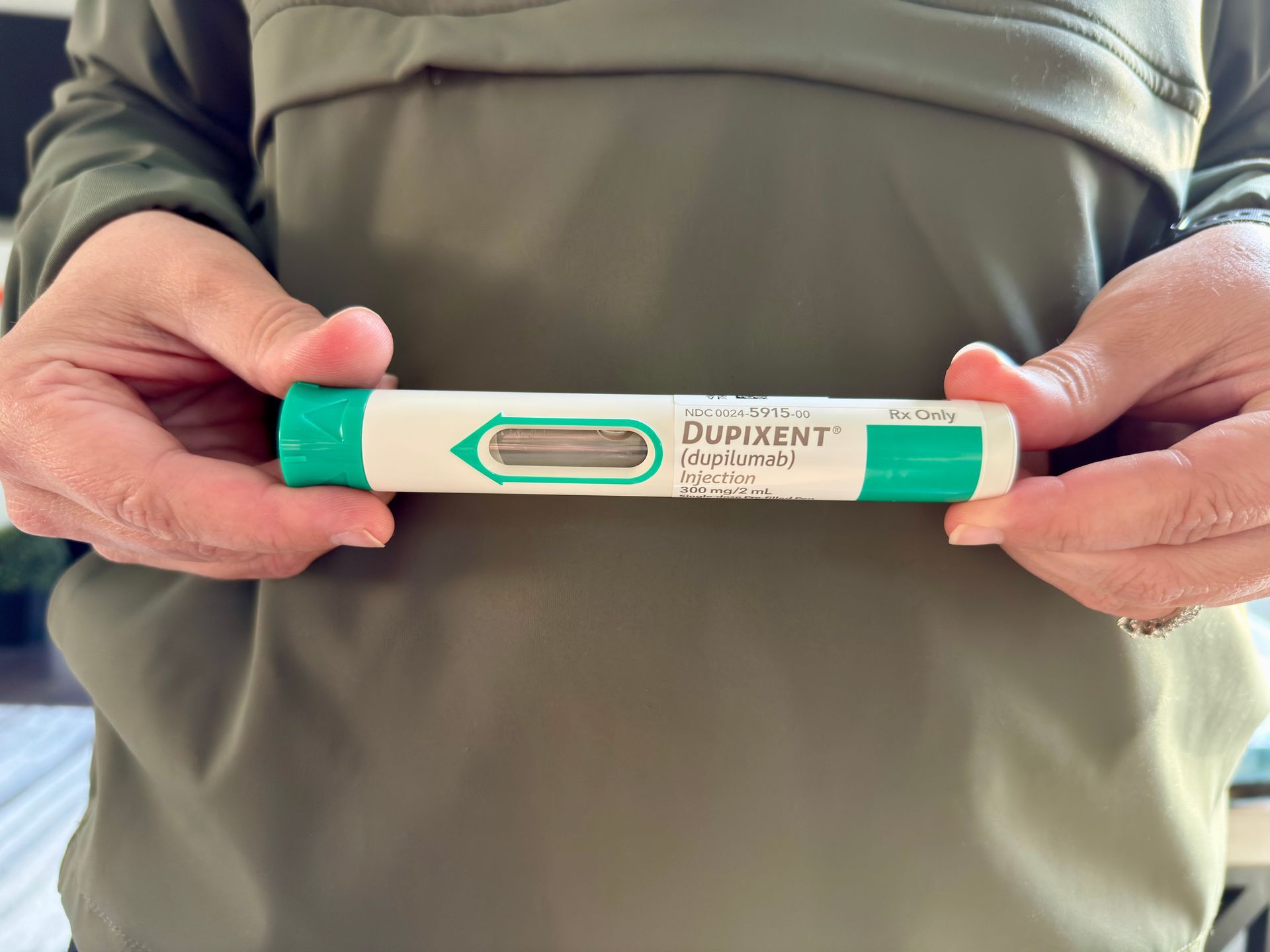
This matters because not all asthma involves the same type of inflammation. Eosinophilic, type 2 inflammation responds well to inhaled corticosteroids and biologic medications that target the IL-4 and IL-13 pathway, such as Dupixent. Non-eosinophilic asthma involves different inflammatory mechanisms and may not respond to these same treatments. FeNO testing helps identify which type of inflammation is present, which directly guides treatment decisions.
How Does FeNO Testing Work?
FeNO testing is one of the simplest tests performed in the office. You will be asked to inhale to full lung capacity and then exhale slowly and steadily through a mouthpiece at a controlled flow rate, typically over about ten seconds. The device measures the nitric oxide concentration in real time as you exhale.
The test requires no needles, no medications, and no special preparation beyond avoiding certain foods and activities that can temporarily affect nitric oxide levels. Nitrate-rich foods like beets and leafy greens, vigorous exercise within an hour of the test, and smoking can all transiently elevate FeNO levels, so patients are typically advised to avoid these before their appointment.
Results are available immediately. A FeNO value below 25 parts per billion is generally considered normal. Values between 25 and 50 indicate moderate eosinophilic inflammation. Values above 50 indicate significant eosinophilic airway inflammation and are strongly associated with steroid-responsive asthma and allergic airway disease.
How Are Pulmonary Function Testing and FeNO Testing Used Together?
The two tests measure different things and together provide a more complete picture of airway health than either one alone.
Spirometry tells you whether airflow obstruction is present and how reversible it is. It is the primary tool for confirming or ruling out obstructive lung disease and for monitoring lung function over time. FeNO tells you whether type 2 allergic inflammation is active in the airways, regardless of whether obstruction is measurable at that moment. A patient can have elevated FeNO, indicating active allergic airway inflammation, while spirometry is still normal, which helps explain why they are symptomatic and guides the choice of treatment before obstruction becomes established.
Used together, the two tests allow Dr. Jacobs to not only confirm whether asthma is present but also characterize the type of inflammation driving it and select the treatment approach most likely to be effective for that specific patient. A patient with elevated FeNO and reversible obstruction on spirometry has a clear eosinophilic, allergic asthma phenotype that is highly likely to respond to inhaled corticosteroids and may benefit from evaluation for biologic medication management. A patient with normal FeNO and borderline spirometry findings leads to a different diagnostic and treatment conversation.
These tests are also used longitudinally. Repeating spirometry and FeNO over time allows Dr. Jacobs to monitor whether treatment is working, whether inflammation is being adequately controlled, and whether the treatment plan needs to be adjusted.
What Else Might Be Evaluated Alongside These Tests?
For patients being evaluated for asthma or respiratory symptoms with a suspected allergic component, pulmonary function testing and FeNO testing are typically part of a broader evaluation that also includes allergy testing.
Food and environmental allergy skin testing or specific blood testing identifies which specific allergens are sensitizing the immune system and contributing to airway inflammation. In South Florida, where year-round dust mite exposure, subtropical pollen, and hurricane-season mold are all clinically significant, identifying the specific allergic drivers of a patient's asthma is essential for building an effective management plan.
For patients with confirmed allergic sensitization and asthma, allergen immunotherapy targeting the specific allergens involved is often the most meaningful long-term treatment strategy available, addressing the underlying immune sensitivity rather than only managing airway symptoms.
Frequently Asked Questions
Do I need to prepare for pulmonary function testing?
Yes. Before spirometry, you should avoid using a short-acting bronchodilator inhaler like albuterol for at least four to six hours, and long-acting bronchodilators for twelve or more hours, unless Dr. Jacobs instructs otherwise. Avoid vigorous exercise, large meals, and smoking in the hours before the test. Wear comfortable, loose-fitting clothing that does not restrict your breathing. The office will give you specific preparation instructions when your appointment is scheduled.
Is spirometry uncomfortable?
The test requires a maximal breathing effort that some patients find tiring, particularly if repeated multiple times to achieve consistent results. It is not painful. Patients with very severe lung disease may find the forced exhalation maneuver somewhat challenging, but for most patients the primary experience is simply the effort required rather than any discomfort. The whole testing session typically takes fifteen to thirty minutes.
Can children undergo pulmonary function testing?
Yes, generally for children five years and older who can follow instructions and perform the breathing maneuvers reliably. Younger children may not be able to cooperate with the test, and alternative approaches to evaluating lung function are used in that age group. FeNO testing is also appropriate for children and is particularly useful for evaluating suspected allergic asthma in school-age kids.
What does it mean if my spirometry is normal but my FeNO is elevated?
A normal spirometry result with elevated FeNO means that significant allergic airway inflammation is present even though measurable airflow obstruction has not yet developed or is not present at that moment. This pattern is clinically meaningful and often explains symptoms like chronic cough, chest tightness, or shortness of breath that occur without obvious spirometry abnormalities. It also indicates that treatment targeting type 2 inflammation, such as inhaled corticosteroids, is likely to be beneficial.
How often do I need to repeat these tests?
The frequency of follow-up testing depends on your diagnosis, the stability of your symptoms, and whether your treatment plan is being adjusted. Patients starting a new asthma medication may have spirometry and FeNO repeated within a few months to assess response. Patients with stable, well-controlled asthma typically have lung function monitored annually. Dr. Jacobs will recommend a monitoring schedule based on your specific situation.
Can I have normal pulmonary function testing and still have asthma?
Yes. Asthma is a variable condition, and lung function can be completely normal between symptomatic episodes. This is one of the reasons asthma can be challenging to diagnose, particularly in patients with intermittent symptoms. When baseline spirometry is normal but asthma is still suspected, a bronchial challenge test or exercise challenge can be performed to evaluate airway reactivity under provocation. FeNO testing also provides useful information when baseline spirometry is normal.
If you have been referred for pulmonary function testing or FeNO testing, or if you have respiratory symptoms that have not yet been fully evaluated, we are here to help. Call our Jupiter office at (561) 510-7232 or book online here to schedule an appointment with Dr. Jacobs.
Disclaimer: The information provided on this blog is for general informational purposes only and is not intended as, and should not be considered, medical advice. All information, content, and material available on this blog are for general informational purposes only. Readers are advised to consult with a qualified healthcare professional for medical advice, diagnosis, or treatment. The author and the blog disclaim any liability for the decisions you make based on the information provided. Always seek the advice of your physician or other qualified health provider with any questions you may have regarding a medical condition.